

Welcome to the first edition of Inside Talent & Hiring newsletter!
As the founder of International HR Club, I spend much of my time speaking with Talent Acquisition Partners, HR leaders, talent professionals and career consultants working across different countries and industries.
Through this newsletter, I'll share the frameworks, observations and lessons that emerge from those conversations, along with my own experience as a Talent Acquisition Partner and an international professional.
We'll explore hiring, people processes, HR Tech and labour markets — and occasionally challenge conventional wisdom along the way.
Context: setting the scene for today's topic
For years, I thought I had a pretty good understanding of how labour markets work.
Over 7+ years in talent acquisition, I hired professionals across HR, Finance, Legal and Business Support functions in both the CIS region and the European Union.
In the last three years alone, I closed more than 250 roles, primarily at mid, senior and head-of-department levels.
Then I became an international professional myself. That's when I realised something I hadn't fully appreciated before.
There isn't one European labour market for international professionals.
There are several overlapping markets, and your experience depends heavily on which one you're trying to enter.
Three Variables That Shape Your Opportunities
Most conversations about working in Europe tend to oversimplify reality.
Questions like: “Can I find a job in Europe with English?” “Which country is best for international talent?” “Do companies sponsor work permits?” don't really have universal answers.
Before we go any further, one important disclaimer.
This article deliberately puts professional skills, experience and role fit aside. They remain the most important factors in any hiring decision.
Instead, I'd like to focus on three structural variables that international professionals often have to navigate in addition to their qualifications:
- Immigration and work authorization
- Language
- Geography
1. Immigration and Work Authorisation
This is often an important filter.
- Do you already have the right to work in the EU?
- Do you need sponsorship?
- Can you work only as an employee, or are contractor arrangements also an option?
A Blue Card, permanent residence or citizenship can significantly change which opportunities are realistically available to you.
2. Language
Most international professionals arrive with English.
However, English alone does not unlock the entire European labour market.
Depending on the company, function and country, you may need:
- English only
- English plus a local language
- Full professional proficiency in the local language
The answer is highly context-dependent.
3. Geography
Europe is not one labour market.
Amsterdam, Budapest, Warsaw, Berlin and Madrid all operate under EU rules, but they often have very different:
- hiring practices
- business language expectations
- concentrations of international employers
- levels of openness towards international talent
Location matters much more than many people initially expect.
Once you combine these three variables, a very different picture starts to emerge. As an international professional, you're not entering one European labour market. You're navigating several distinct layers of opportunity.
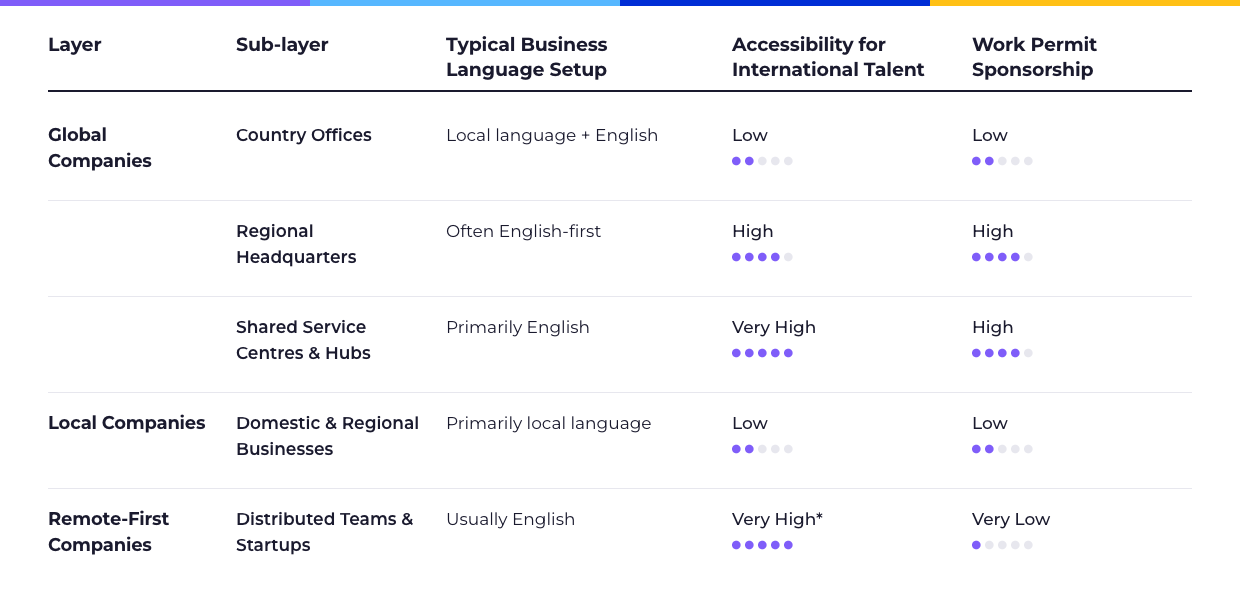
3 layers of European Job Market for International Talent
Layer 1. Global Companies
This category is more nuanced than it may initially appear.
In my experience, this is where many international professionals make their first incorrect assumption.
A global company doesn't automatically mean an English-speaking workplace.
Not all global companies hire in the same way. For simplicity, let's divide global companies into three sub-layers:
- Country Offices
- Regional Headquarters
- Shared Service Centres & International Hubs
Country Offices
Think PepsiCo Poland, Coca-Cola Hungary or Roche Spain.
Although these organisations are global, many country-level roles remain highly local.
If you're an Account Manager, HR Business Partner or Finance Manager supporting a specific market, the local language is often essential.
Global company does not automatically mean English-speaking environment.
In many cases, it means: Local language + English.
Regional Headquarters
Regional headquarters often support multiple countries simultaneously.
As a result, they tend to be naturally more international.
English is frequently sufficient because teams operate across borders and communicate with colleagues from multiple markets.
These environments also tend to have higher concentrations of expats.
Shared Service Centres and International Hubs
This is probably one of the least understood parts of the European labour market.
A US company may run finance operations from Budapest, HR operations from Warsaw and engineering teams from Berlin.
Although these organisations physically sit in a particular country, operationally they often function as international environments.
English is frequently the primary working language.
Additional languages become an advantage rather than a barrier.
I experienced this dynamic firsthand. While living in Hungary, I worked entirely in English as part of a global talent acquisition team supporting multiple markets.
I also hired into shared service environments where English was the primary working language and additional languages were considered an asset rather than a requirement.
For many international professionals, these hubs can become one of the most accessible entry points into Europe.
Layer 2. Local Companies
These are companies that primarily operate in one country or a small number of neighbouring markets.
They may have German, Polish, Finnish or Hungarian roots and be extremely successful businesses.
But they operate under a very different set of assumptions:
- The local language is often not just a preference.
- It is part of the business infrastructure.
- Meetings happen in the local language.
- Documentation is written in the local language.
- Clients expect communication in the local language.
As an international professional, it's important to understand that you may not be competing in an international labour market at all.
You're entering a highly local one. That doesn't mean international professionals cannot succeed there. But in many cases, they are not the primary talent pool these organisations naturally hire from.
Layer 3. Remote-First Companies
This layer often feels the most international.
And in many ways, it is.
These organisations may be startups, technology companies, crypto companies, iGaming firms or other fast-moving industries operating with distributed teams.
They hire internationally by design.
Contractor agreements, Employer of Record solutions and B2B arrangements are common.
However, there is an important nuance. International hiring does not automatically mean immigration support. Many remote-first companies are perfectly comfortable hiring internationally.
But they are often less willing or less equipped to sponsor visas and relocation.
For professionals who already have work authorisation, this market can offer tremendous opportunities.
For those who still require sponsorship, the picture may be much more complicated than it initially appears.
What This Means in Practice
This is why broad statements such as “English is enough” or “You need the local language” rarely tell the whole story.
The same professional can be highly competitive in one layer of the market and almost invisible in another.
Before starting your search, ask yourself three structural questions.
- Do I have the legal right to work in the EU?
- Which languages can I realistically work in?
- Which layer of the labour market am I targeting?
If you're an international professional in Europe, does this framework reflect your experience? Or is there another layer you would add?
Thanks for reading the very first edition of Inside Talent & Hiring.
If you enjoyed it, I'd love to have you along for future editions. Feel free to subscribe and join the conversation. Don't forget to hit subscribe 🫶🏻