

When I wrote the first edition of this newsletter, I looked at the European labour market through the lens of a recruiter.
This time, I'd like to look at it from the candidate's perspective — specifically, as an international Talent Acquisition professional searching for a role in Europe.
Over the past few years, I've been on both sides of the hiring process.
I've hired hundreds of professionals across the CIS region and Europe, but I've also been an international candidate myself, looking for Talent Acquisition roles after relocating.
In addition to the three structural variables we explored in the first edition: work authorisation, language and geography — Talent Acquisition professionals face another set of considerations that can significantly shape their job search.
Your position within the TA function, the markets you've hired for and the way your expertise transfers become just as important.
That's what I'd like to explore in this edition.
Here are four things I'd consider before starting a Talent Acquisition job search in Europe.
1. Positioning: Understand What Kind of Talent Acquisition Professional You Are
One of the biggest mistakes I see is treating Talent Acquisition as a single profession.
It isn't.
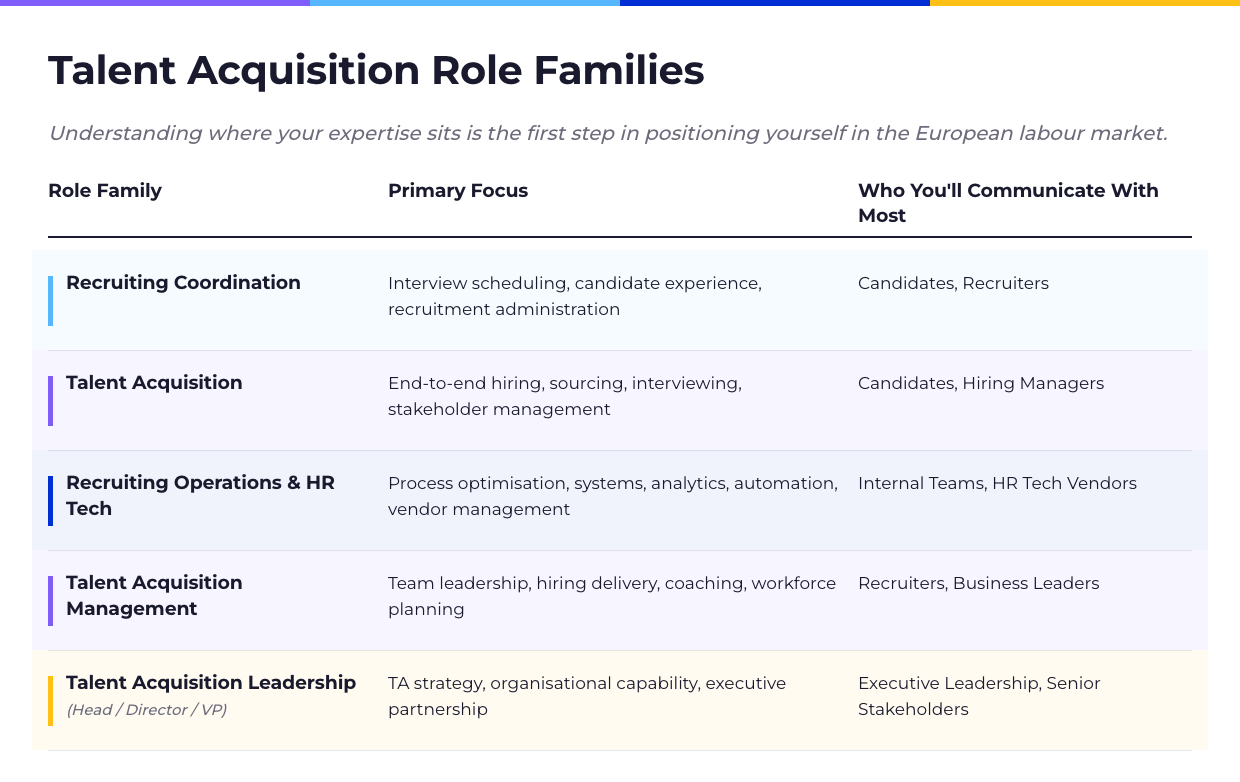
A Recruiting Coordinator, a Talent Acquisition Partner, a Recruiting Operations Specialist and a Head of Talent Acquisition may all belong to the same function — but their day-to-day work is fundamentally different:
- Some roles are highly operational.
- Others are deeply strategic.
- Some revolve around candidate conversations.
- Others focus on systems, analytics, process design or leadership.
Understanding where your own expertise sits is the first step in understanding where you'll be most competitive.
Talent Acquisition Role Families
2. Communication: Remember That Language and Communication Skills Are at the Core of Your Profession
Across Talent Acquisition, communication is one of your primary professional tools. The audience changes depending on the role:
- A recruiter may spend most of the day speaking with candidates and hiring managers.
- A Recruiting Operations specialist may work more closely with HR Tech vendors, data owners and internal teams.
- A Head of Talent Acquisition may spend more time influencing executives than interviewing candidates.
But across every role, the ability to communicate clearly, build trust and influence decisions remains central to the job.
This is why language and ability to relate your ideas to others become much more than a communication tool.
It becomes part of your professional expertise.
3. Market Fit: Choose the Right Employer Layer
This is where the framework from the previous newsletter becomes practical.
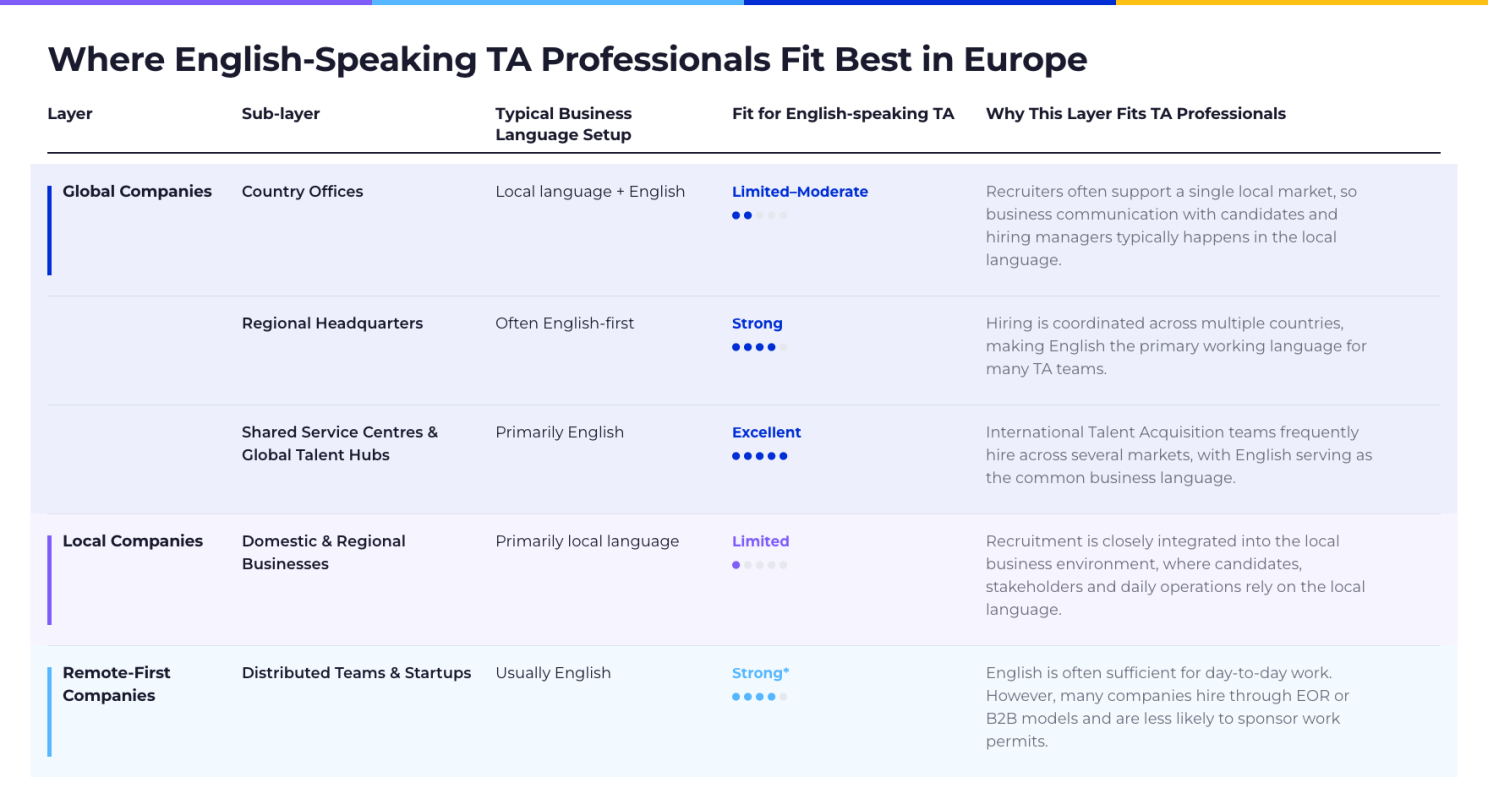
If English is your primary working language, not every layer of the European labour market offers the same opportunities.
One of my own examples comes from my time at Wolt.
Although I was based in Hungary, my scope wasn't limited to the Hungarian market.
I recruited Finance professionals across several European countries, and English was the common working language within our Talent Acquisition team and among most of our stakeholders.
I didn't need Hungarian because I was supporting an international function rather than a purely local hiring operation.
That distinction matters.
Where English-Speaking TA Professionals Fit Best in Europe
4. Skills and Expertise Transferability: Map What Travels and What Needs Local Adaptation
Your seniority isn't the only thing companies evaluate. Your area of expertise within Talent Acquisition matters too.
For example, if your background is in hands-on recruiting, the markets you've hired for can become an important part of your profile.
For example, recruiting software engineers in Central Asia can involve very different market dynamics from recruiting the same profiles in Germany:
- Candidate expectations differ.
- Total rewards expectations differ.
- Response rates differ.
- Employer value propositions and Brand perceptions differ.
Even the way candidates evaluate opportunities can be completely different.
The same principle applies across other Talent Acquisition specialisations.
If your background is in Recruiting Operations, HR Tech or Talent Analytics, companies will look at different types of expertise — for example, the systems you've implemented, the operating models you've built or the scale at which you've worked.
The more senior you become, the more this balance begins to shift.
Leadership roles rely less on tactical market knowledge and more on recognising broader hiring trends, setting direction and helping teams translate strategy into local execution.
That doesn't mean your previous experience loses its value. Quite the opposite.
Many Talent Acquisition skills are remarkably transferable across borders.
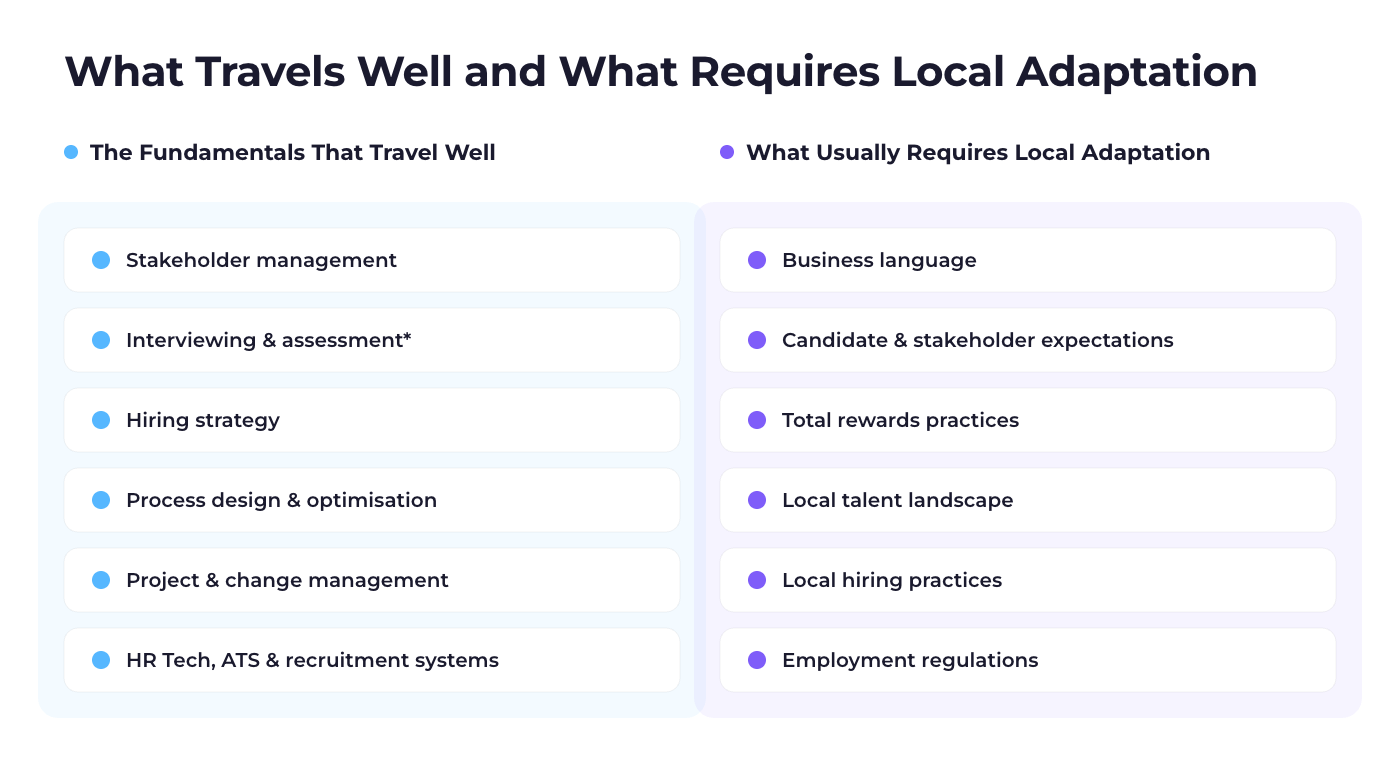
Disclaimer: As with most things in Talent Acquisition, the answer is “it depends.” Every company has its own operating model, hiring setup and market realities. The purpose of this framework isn't to draw rigid boundaries, but to highlight which competencies are worth building.
Understanding the difference between transferable expertise and market-specific knowledge is what helps many international Talent Acquisition professionals reposition themselves successfully in a new country.
Closing Thoughts
Finding a Talent Acquisition role in a new country can feel overwhelming.
There are more variables to consider than many of us initially expect, and it's easy to assume that moving into a new market means starting again.
Fortunately, that's rarely the case.
Most of your professional expertise doesn't disappear when you cross a border. The key is understanding what already travels well, what requires local adaptation and where your profile naturally has the strongest fit.
Once you start looking at the market through that lens, the process becomes more strategic and, hopefully, much less frustrating.
You may not be able to control every variable in the hiring process.
But you can build a focused strategy, communicate the value of your experience and concentrate on the employers most likely to recognise it.
A successful international job search isn't only about finding the right opportunity.
It's also about positioning yourself where the right employers can see your value.
Let's Exchange Perspectives
If you could give one piece of advice to an international Talent Acquisition professional looking for a role in Europe today, what would it be?