
Professional communities have existed for centuries (saying hi to Medieval Guilds), yet many people still see them as little more than networking groups.
In reality, they can become a source of knowledge, career opportunities, partnerships and long-term professional relationships.
After spending the past few years building the International HR Club while also participating in many other professional communities, I've noticed something interesting.
Two people can join exactly the same community and walk away with completely different outcomes.
One finds a new job. Another builds a consulting business. Someone else meets future business partners. Others simply stay informed about what's happening in their profession.
The difference usually isn't the community itself. It's how people choose to engage with it.
Although this article focuses on HR and Talent communities, the same principles apply to almost any profession.
What Is a Professional Community?
A professional community brings together people around a shared profession, industry or area of expertise.
Examples include:
- Company alumni communities
- University alumni networks
- Professional associations
- Industry communities
- Functional communities (HR, Finance, Engineering, Product, Marketing...)
Some operate locally. Others connect professionals across multiple countries. Some are built around learning, while others focus on networking, career development or knowledge sharing.
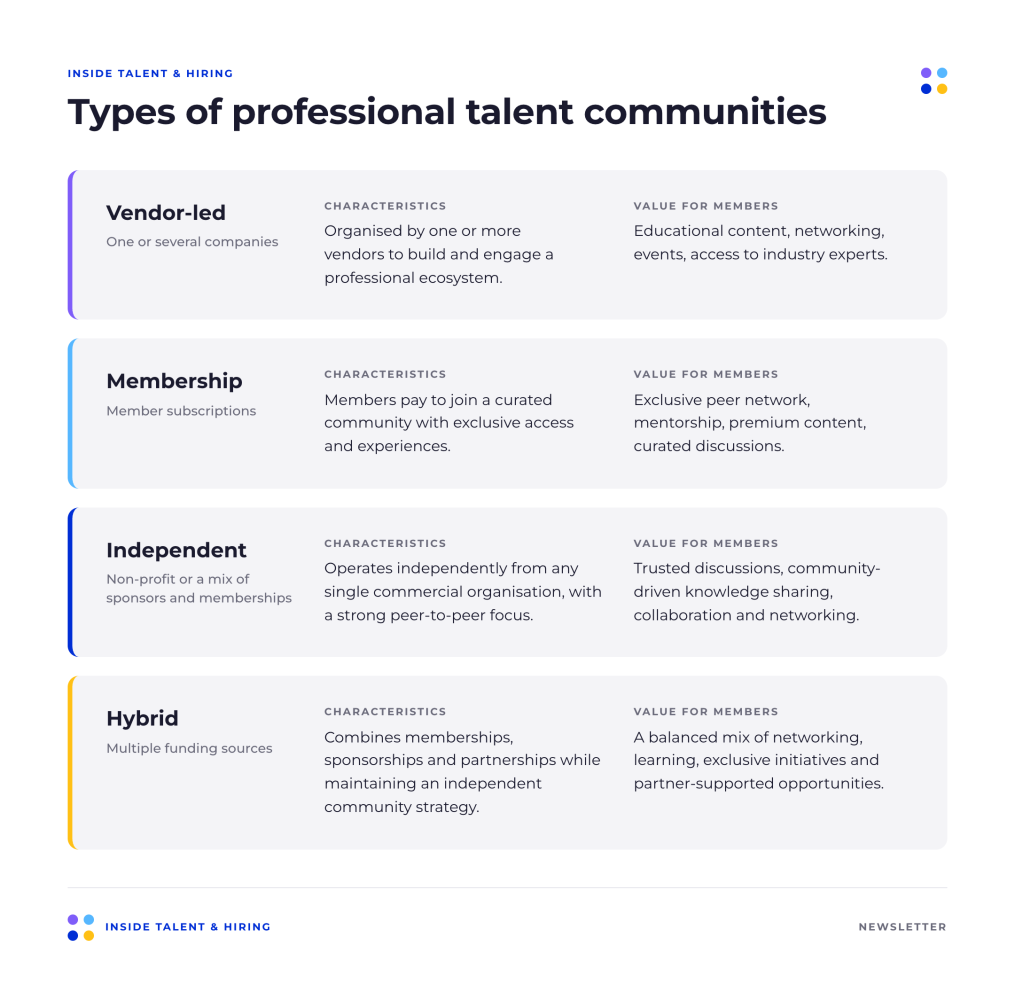
As shown in the infographic above, we've categorized most Talent Communities into four main categories:
Vendor-led Communities: Created or funded by one or several companies. Members receive networking opportunities, events and educational content, while sponsors build relationships with potential customers and gain visibility.
Membership Communities: Professionals pay to become members. The focus is usually on curated networking, exclusive events, mentorship and high-quality discussions.
Independent Communities: Built around a location or a mission. Some operate as non-profits, while others collaborate with multiple partners without being tied to one company. Their biggest asset is often trust.
Hybrid Communities: Many mature communities combine several funding models. They remain independent while collaborating with multiple partners and sponsors to support events and community initiatives.
Okay, now that we've covered what Talent Communities are, let's explore how we can actually benefit from these professional networks 👇
Three Ways Almost Every Community Creates Value
Regardless of your profession, most communities create value in three ways.
Expand Your Network
Professional communities make it easier to connect with peers through Slack groups, WhatsApp chats, Telegram communities, virtual coffee chats and in-person events.
Whether you're looking for mentors, collaborators or simply people facing similar challenges, communities shorten the distance between professionals.
Learn from Real Practice
One of the greatest advantages of communities is learning directly from practitioners.
Instead of theory, members often share implementation stories, templates, hiring strategies, lessons learned and practical advice based on real experience.
Build Your Visibility
Communities aren't just places to consume content.
Speaking at events, contributing to discussions, sharing case studies or volunteering to help organise initiatives all increase your visibility and professional reputation.
The Same Community Creates Different Value for Different People
Professional communities become most valuable when you approach them with a clear objective.
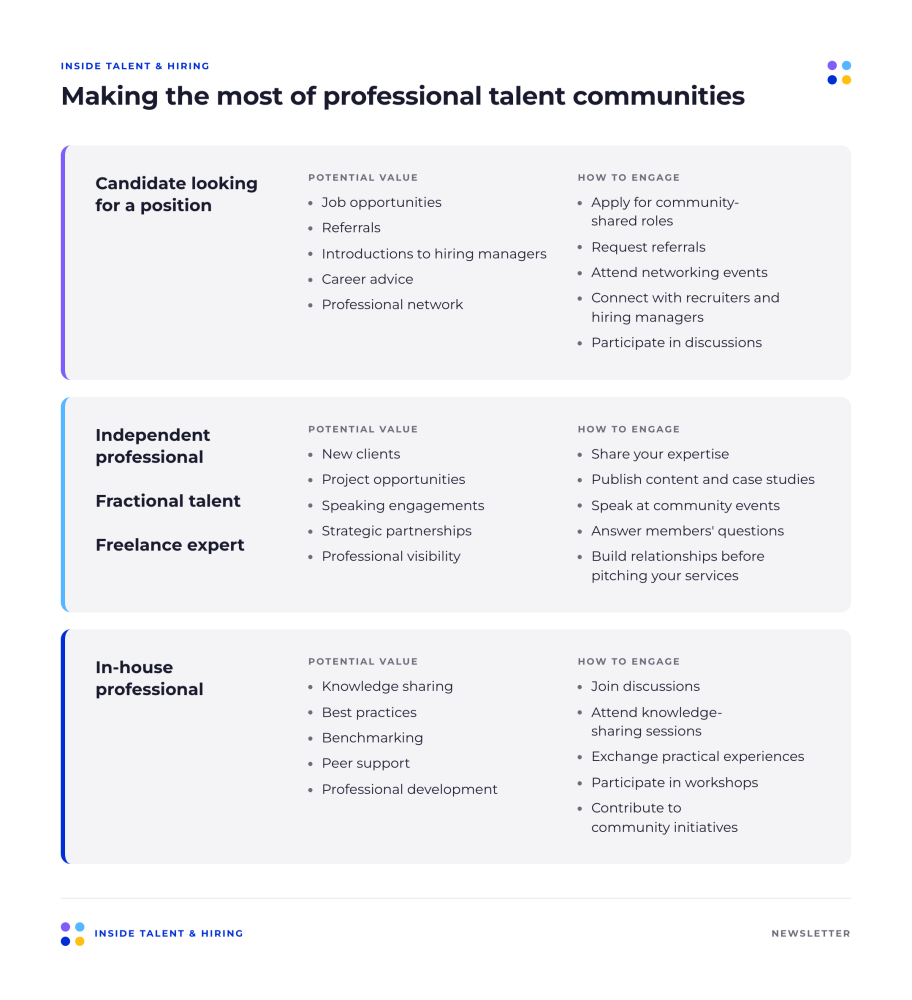
Let's Look at Three Different Perspectives: a Candidate, an Independent Professional, an In-house Professional
If you're a Candidate
Communities can become an additional recruitment channel.
Beyond public vacancies, members often share:
- Unlisted or confidential positions: access to exclusive job opportunities that are not publicly advertised.
- Referrals: candidates can either reach out directly to someone in their network for a referral or respond to referral requests shared by other community members.
- Exclusive introductions: direct access to hiring managers and key decision-makers.
- Networking conversations: meaningful connections that often lead to future job opportunities, even when no role is being discussed initially.
Many opportunities begin with a conversation before they ever appear on a job board.
If you're an Independent Professional
Consultants, freelancers and fractional leaders often find their next clients through trusted communities.
Members regularly ask for recommendations for: consultants, recruiters, trainers, keynote speakers, facilitators, coaches.
If you're an In-house Professional
Communities provide a space to exchange ideas with peers facing similar challenges.
They help you: benchmark your organisation, discuss practical cases, stay informed about emerging trends, discover new technologies, continuously develop your professional skills.
One Community Is Rarely Enough
Many professionals participate in several communities at the same time.
For example: a local community for face-to-face networking; an international community for broader perspectives; a niche community focused on a specific topic such as AI, HR Tech or Leadership.
Each serves a different purpose.
Together, they create a much richer professional ecosystem than any single community could offer.
Final Thought
Joining a professional community is only the first step.
The real value comes from participating: ask questions, share your experiences, help other members, contribute when you can.
Professional communities work much like relationships: the more you invest, the more opportunities tend to come back to you.
If you're an HR or Talent professional working internationally, I'd be delighted to welcome you to the International HR Club. We bring together HR professionals from around the world to exchange best practices, discuss real-life cases, grow their professional networks and discover new opportunities.
You can apply to join the community here: https://tally.so/r/VLbbjl