

- spoiler (it’s not what you think).
Guest author
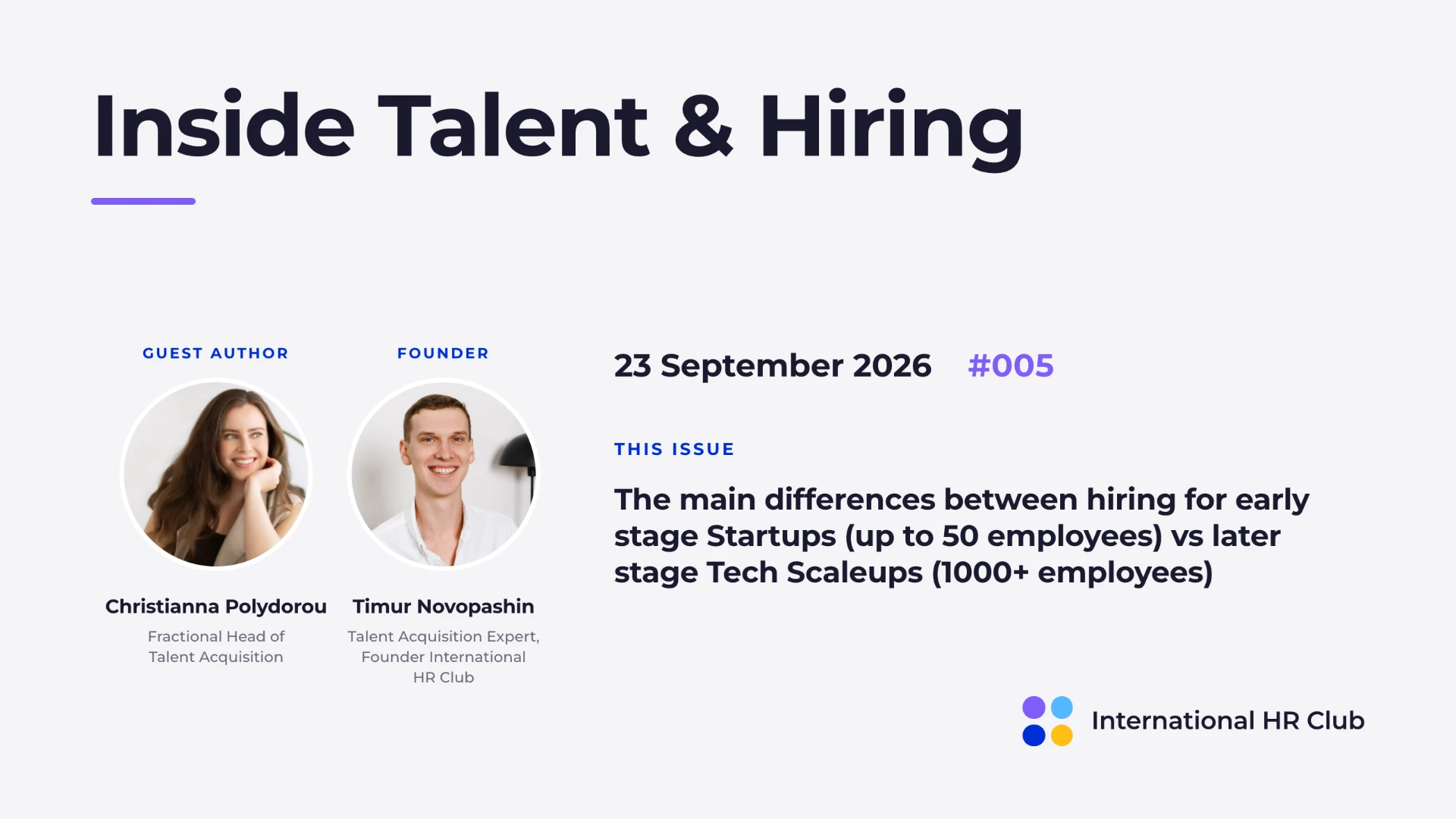
This edition of Inside Talent & Hiring by International HR Club is brought to you by Christianna Polydorou, our guest author and expert.
Christianna helps early stage tech startups build their hiring plane while flying. Christianna has worked for a recruitment agency, RPO and in-house in Tech. Now, Christianna steps in as a Fractional Talent Acquisition Partner for early stage AI-native startups.
I've hired for teams of 16 and teams of 8000. But all in the tech industry, the latter during hypergrowth when the companies were expanding rapidly and doubling in size.
I could write about startup vs corporate hiring, but that would be too boring and predictable. And I've mostly worked with fast-paced tech companies. So I think the more interesting question is whether and how the shape of hiring actually changes within the tech industry itself depending on the company stage (not size only).
These views are my own and you might not agree but it's based on my personal experience and opinion.
Size isn't everything when it comes to level of ownership
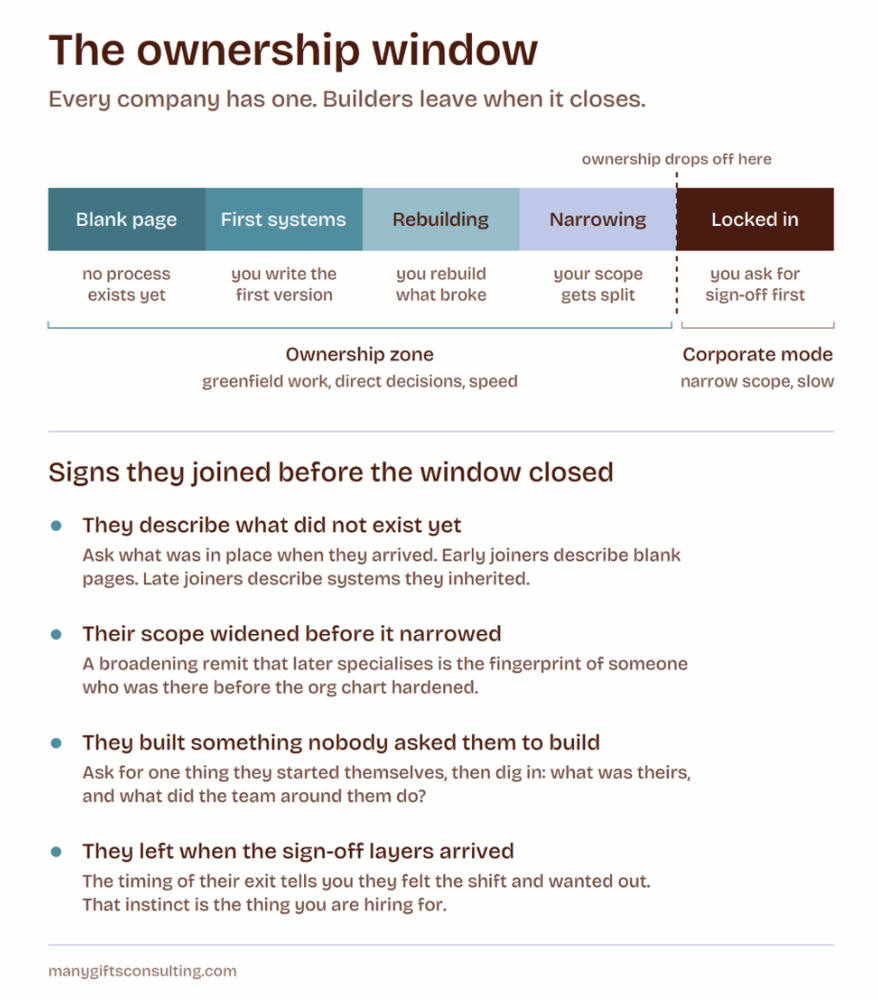
There's always a moment in a company's growth where ownership (here my definition is: not asking for permission to take action) drops or disappears. And usually it happens fast and depends on company culture, structure and trust levels and is not really about company size only.
I joined Klarna when there were 3000 people in a few countries. Playbooks already existed, TA process was super structured and ran like clockwork. Although I had a high degree of trust, worked directly with c-level and could take initiative, there wasn't that much to build from scratch and there were specific people already responsible for every part of the Talent acquisition process so the scope was quite narrow. I did take ownership over some projects but there were less opportunities to do so than in an early stage zero-to-one environment.
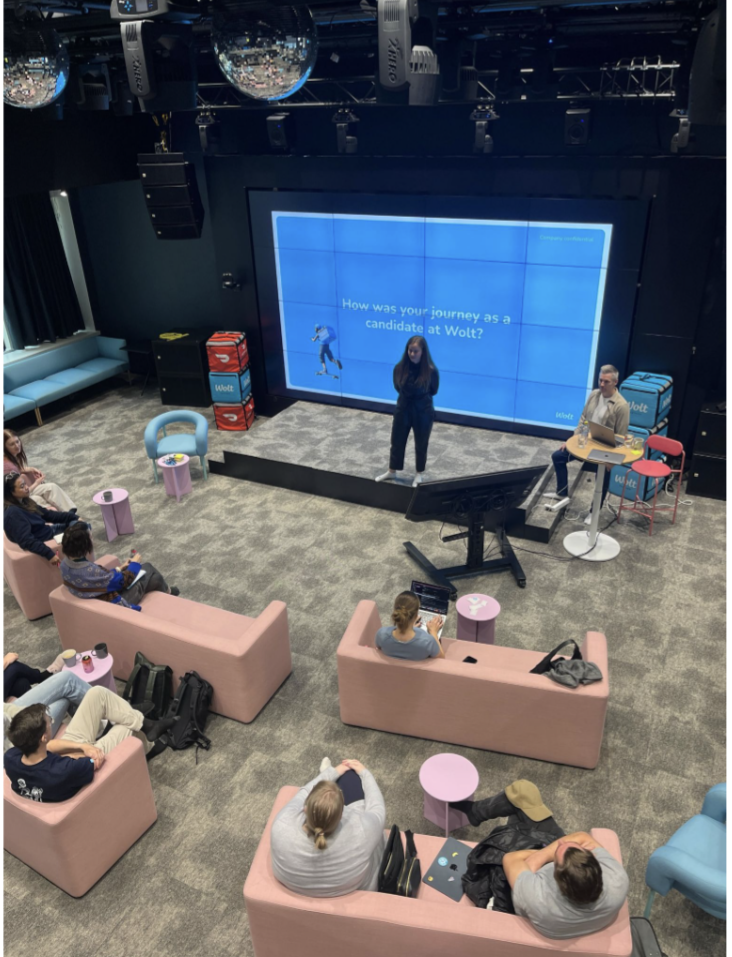
I joined Wolt when it was 4000+ people, teams were scattered between 18 countries, each country followed their own hiring practice, very few processes existed and previous playbooks were outdated. Hiring teams in Greece hired completely differently to teams in Kazakhstan. I had so much room to build despite it being a huge company on paper already. For example I built a global interviewer training program that never existed before. But after some time, I had to hand over certain projects to new people that were hired for very specific scopes. This is where ownership drops and scope narrows and less 'building' happens. But on the plus side every scope becomes much more sophisticated and the goal becomes operational excellence.
Every startup I've hired for (10-50+) always required me to build something from scratch outside of just hiring: spanned from finding office space, filming employer branding videos, creating playbooks, implementing an ATS or other new tools and building scorecards etc from scratch. HOWEVER I also know of some early stage startups where the founders are total micromanagers and wouldn't let their founding team do anything without permission and wanted them only focused on execution and no strategy.
What this means for hiring: Although company size may be an indicator of how much ownership someone has had in their job, it's not always the case. Just because they worked at a 0-1 or bigger tech company, doesn't mean that they had less ownership or more. The best way to determine how much ownership someone has is to ask the right questions about what they really built and how.
Speed: Is less about speed and more about who has decision making power
Early stage companies generally move very fast. At least when the leadership team gives their team decision making power and doesn't act as a bottleneck for every decision.
Scaleups: There are usually cleanly defined layers of leadership that decisions need to clear before things can happen. This is where things slow down.
What this means for hiring: you can make a hire much faster in early stage companies once you have the right candidate in the funnel. It's much easier to get founders to sign off on a budget increase for a stellar candidate in an early stage company than to get permission from c-level in a company of thousands.
But if we're talking about speed of executing tasks, in my experience this is similar in a startup of 20 and a tech scaleup of 1000+ and depends more on performance culture and expectations.
Back when I was at Klarna we always joked that your time at the company can be measured in dog years because so much happens in such a short amount of time that it feels like you've already lived a year in a month.
When you are in an industry leading company or one that has an ambition to increase market share and reach certain milestones fast, expectations are high and usually performance metrics are aligned with those expectations at both startups and scaleups.
Attracting VS Hunting
I personally believe Talent Acquisition needs to be approached like client acquisition, with both an inbound and outbound acquisition strategy.
The amount of inbound vs outbound needed at each stage differs significantly. This also changes a lot depending on the specific market you're hiring in and other macroeconomic conditions - is it an employer's market or a candidate's market? And also how big is the talent pool and how aligned is your comp package with market benchmarks. Moreover, does the talent live in the same channel you're using to try and attract them?
Early stage: 80% hunting, 20% attracting
Early stage startups should work with the assumption that people aren't lining up to work for them because they don't know why they should want to work for them as opposed to a larger company that already has significant market share.
This means that you can expect a lot less applications on job posts compared to bigger tech brands and most of the work will be in sourcing the right candidates and convincing them it's a great opportunity.
LinkedIn inmail response rate will also be lower so leveraging the existing teams network for referrals is a low hanging fruit at this stage.
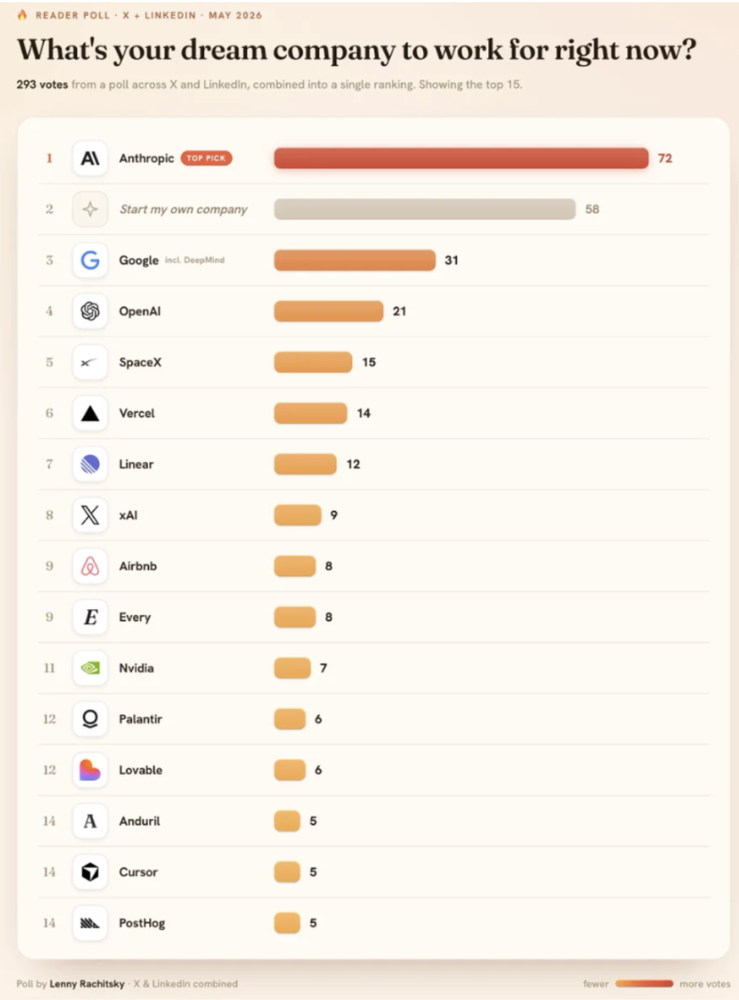
Tech layoffs have changed the game a bit on this with more applications coming in from all angles but still, there are a few companies that everyone is competing for - check this list below of where top tech talent want to work.
Scaleup: 80% attracting, 20% hunting
When you have a strong brand in an employer's market (more candidates competing for fewer jobs), it is likely that suitable candidates will apply for the role you're hiring for. So the challenge then is to make sure you're able to identify this talent among a huge pile of applications. Assuming your pipeline is already strong, less time is needed on sourcing passive candidates (although I personally recommend always doing this anyway since the best person for the job might not be actively applying).
In this situation, you basically want to make sure that the quality of applications is also high (not just quantity). Targeted employer branding campaigns on the right channels, sourcethons, automated application filters etc help with this.
But no matter the company brand, there will always be niche roles that require a lot of sourcing.
The difference here is that your response rate to outbound outreach will almost always be higher when it's attached to this kind of brand so it is easier. For example, a good response rate for linkedin inmails via LinkedIn recruiter is around 35%. I often had a response rate closer to 60% when hiring for companies like Klarna. The brand was doing the heavy lifting. Optimizing for a great candidate experience with the heavy volume was the difficult part.
What kind of recruiter each stage actually needs
The company isn't the only thing that changes stage to stage. The recruiter who thrives does too.
Early stage: this is a match for builders. People who are scrappy, like building from scratch, haven't followed a particularly linear career path, and have taken initiative elsewhere, maybe started their own company or community. They like doing a bit of everything rather than just putting bums in seats. They need to be very strong at sourcing, creative about building both inbound and outbound, and willing to pick up other people-and-talent work like comp benchmarking, employer branding etc.
Later-stage tech: this suits people who are more structured and know exactly which type of recruitment they want to focus on: exec, GTM, tech, high-volume, graduate, and so on. They're still happy to pick up tasks outside their main remit, but they want clearer boundaries around what is and isn't their job. Stronger leadership, operational excellence and change management experience are a real advantage here.
If you're a recruiter, how do you know which one to join? If ambiguity energises you more than it drains you, and you'd rather build the process than perfect one that already exists, early stage is where you'll thrive. If you want to go deep on one type of recruiting and build real expertise inside a strong operating system, later-stage tech will suit you better. Neither path is more senior than the other. They're just different games.
I've done both and realized that I'm definitely more of a builder, everytime I felt like I wanted to leave a job it was because my scope became too narrow and I had less room to build freely.
So, to summarize
What actually changes between hiring for an early-stage startup and a tech scaleup comes down to four things:
- how much room you get to build without asking permission
- who holds the power to say yes and how fast decisions are made, executing speed can be similar in both
- whether your job is mostly finding talent or filtering it
- the kind of recruiter each stage is built for.
Hiring for early stage tech vs late stage tech is not as different as people might think. Execution speed is similar. The only thing that really changes over time is the level of ownership and what kind of recruiter thrives in each. But the same candidates can be a fit for both, this can only be tested in an interview and very rarely through looking at a CV only.
Want to connect or learn more about Christianna's work?
Connect with Christianna on LinkedIn: Christianna Polydorou
Explore Christianna's work: manygiftsconsulting.com