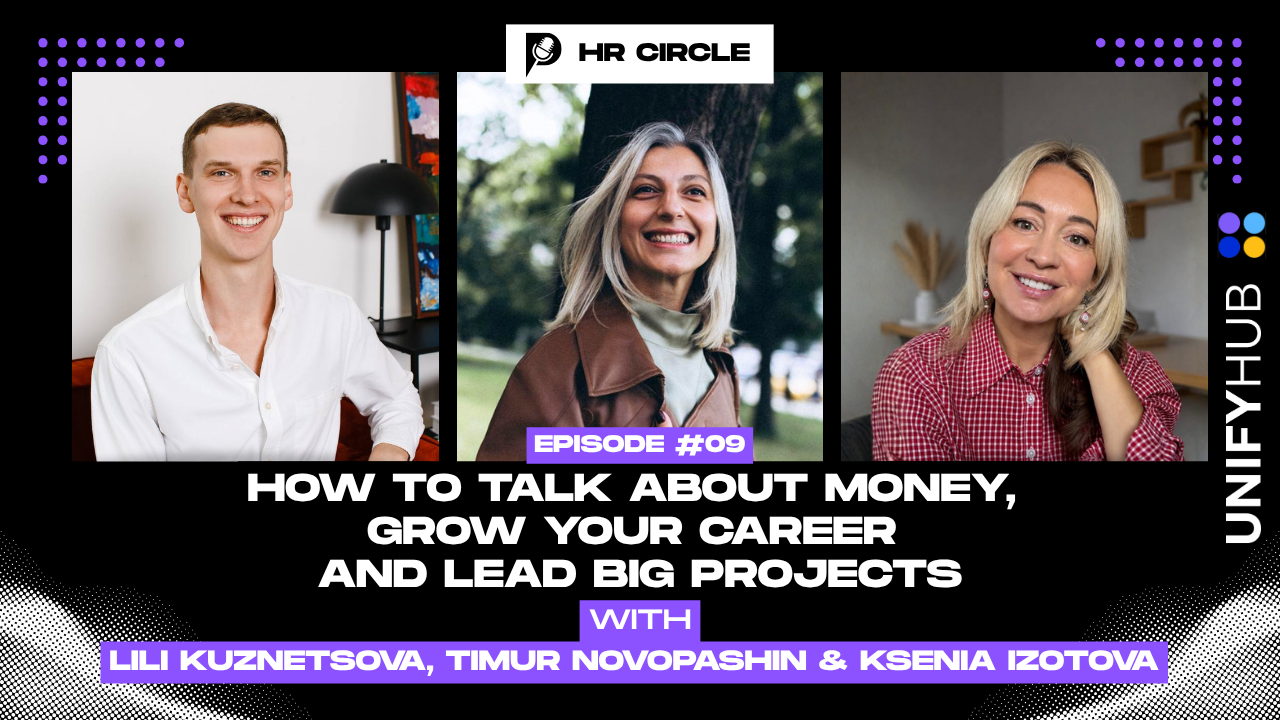



For the new episode of HR Circle, a podcast by International HR Club and UnifyHub we sat down with Lili Kuznetsova, a global Talent Leader who has worked across hospitality, retail and tech industries.
This time, we wanted to look at some very practical questions from the HR side of the table.
How do you actually get promoted? When should you ask for a salary increase? What happens behind the scenes when these decisions are made?
And on the HR side: how do you implement new processes, get senior stakeholders on board and introduce AI tools that employees will actually use?
We talked about:
- how to get promoted inside a company
- when and how to ask for a salary increase
- what managers consider when making these decisions
- how HR leaders align multiple senior stakeholders
- why you shouldn’t implement every HR “best practice”
- what AI implementation in HR actually looks like
Want to get promoted? Make your ambitions visible
Your manager cannot read your mind.
You can be a great performer, take on more responsibility, contribute outside your immediate scope and quietly hope that someone will eventually notice:
“This person deserves a promotion.”
Sometimes they will.
But if you want to grow, at some point you need to say it.
One of Lili’s points was very simple:
Doing a great job is necessary, but don’t expect your manager to guess your ambitions.
If you want a promotion, have the conversation.
Explain that you want to grow. Ask what opportunities exist. Be ready to take on new responsibilities, learn new skills and work with your manager on what getting to the next level would actually require.
But there is an important first step.
Before asking for a promotion, make sure you’re consistently delivering in your current role.
If the results aren’t there yet, focus on that first.
Lili also highlighted something I think is often overlooked: follow your curiosity.
Join projects outside your immediate scope. Volunteer for something you genuinely want to learn. Keep developing your skills.
Career growth doesn’t always start with a new title. Sometimes it starts with taking on something new.
And what if you simply want to earn more?
This was probably one of the most practical parts of our conversation.
There is a big difference between starting with:
“I think I’m underpaid.”
and:
“Increasing my income is important to me. What opportunities do I have to do that here?”
The second one opens a conversation.
Maybe your scope needs to change. Maybe there is another position you can grow into. Maybe there is a salary review coming up. Or maybe the company simply doesn’t have the budget right now.
And timing matters.
In many companies, your manager cannot simply increase your salary next month. Compensation decisions are tied to review and budgeting cycles.
Salary increases can also look very different across markets. In Europe, for example, annual increases may be significantly smaller than what professionals from some other markets are used to.
The important part is understanding what is actually possible in your company and what you need to do to get there.
Good HR isn’t about implementing everything
We then looked at things from the HR leader’s perspective.
When Lili joined her current company, she came from a large corporate environment and could immediately see a long list of HR processes that could be introduced.
But she quickly realized that just because an HR tool or process exists doesn’t mean the company needs it right now.
Performance management was one example.
Instead of introducing a process simply because it was considered “best practice”, the team identified stakeholder pain points, collected feedback and brought decision-makers together.
The result was a process people actually used, with participation above 90% across key parts of the review cycle.
And this becomes even more complicated when you’re working at company level.
You might have 10 or 15 senior stakeholders, all with different opinions and priorities. HR’s job isn’t necessarily to make the decision for them.
Sometimes it is to understand the different perspectives, find common ground and help the right people reach a decision together.
What does AI implementation in HR actually look like?
One of my favourite examples from the episode was an internal AI bot designed to answer recurring employee questions.
The idea sounds simple:
Give AI your HR knowledge base → employees ask questions → AI answers them.
The reality was much more complicated.
The team discovered that documentation written for humans wasn’t necessarily documentation AI could use effectively.
Screenshots had to become text. Instructions needed restructuring. Data sources had to be controlled. The bot needed extensive testing.
Even the interface mattered.
The initial idea of using an open Slack channel created another problem: people weren’t necessarily comfortable asking sensitive questions where colleagues could see them.
“My manager doesn’t want me to raise my salary. What should I do?”
Not exactly the question you want to post publicly in front of your colleagues.
So the team eventually moved to a private search-like interface where employees could ask questions safely.
For me, it’s a great example of what AI implementation in HR actually looks like.
It isn’t just about choosing an AI tool.
It is about technology, processes, data and human behaviour.
What stayed with me
We covered quite a lot in this conversation, from individual career growth to company-wide HR transformation.
But there was one common thread.
Whether you’re trying to get promoted, negotiate a higher salary, introduce a new performance process or implement AI, understanding the people on the other side matters.
- If you want to grow, don’t assume your manager knows. Have the conversation.
- If you want to earn more, understand what opportunities and constraints actually exist.
- If you’re building an HR process, understand what the business really needs before implementing it.
- And if you’re introducing AI, understand how employees will actually use it.
Sometimes the answer isn’t another tool or another process.
Sometimes it starts with understanding how things actually work from the other side of the table.
Watch the full HR Circle conversation here: https://youtu.be/IIhB9gQBK7U
What’s one thing about career growth, salary decisions or AI in HR that you wish more people understood about how it actually works from the HR side?