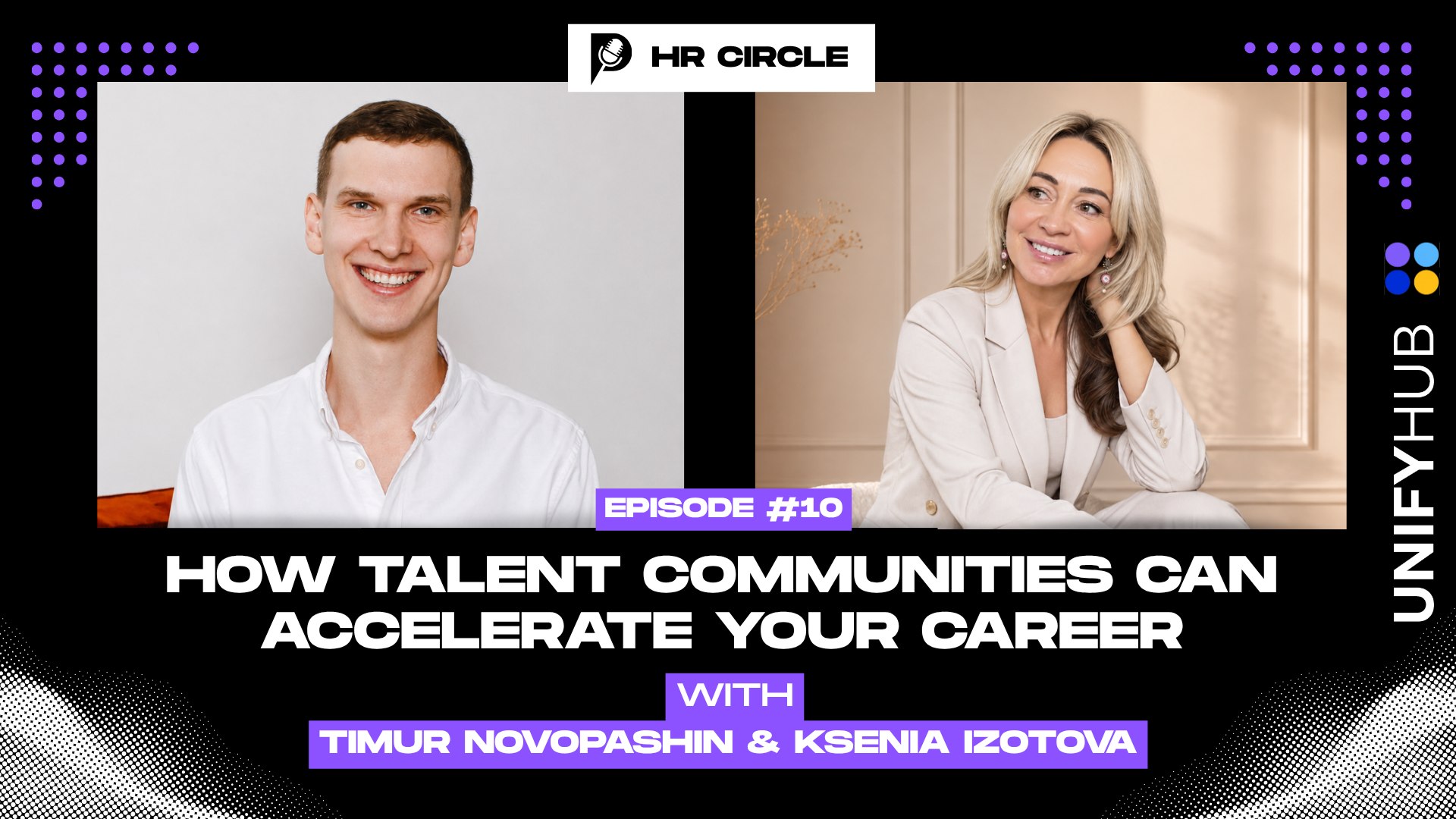


For the new episode of HR Circle, a podcast by International HR Club and UnifyHub, we did something a little different.
This time, I was not the host.
I was the guest.
Together with Ksenia Izotova, we talked about the story behind International HR Club: how it started as a small private chat, why HR professionals need peer-to-peer spaces, what makes a community actually alive, and where we are heading next.
Today, International HR Club brings together 2,000 HR, People and Talent professionals across 50 countries.
But it did not start as a business.
It started with a simple need:
HR, Talent, People professionals working globally need a trusted space to exchange experience, ask questions, learn from each other and feel less alone in the complexity of international work.
And I think this need is becoming even more important now.
Because HR professionals do not have a lack of content.
We have reports. Frameworks. LinkedIn posts. Webinars. AI tools. Playbooks. Benchmark studies. Newsletters.
The real question is different:
Who do you trust when you need to make a real decision?
Information is everywhere. Context is not.
When I moved to Hungary in 2022 and started hiring across the EU, I entered a completely new professional reality.
Different markets. Different hiring practices. Different legal and cultural contexts. Different expectations from candidates and hiring managers.
At the same time, my team was spread across multiple countries: Denmark, Japan, Finland, Germany, Czechia and beyond.
And even though I was working in a global company, I still felt the need for something very simple:
A space where I could ask peers:
- “How does this work in your market?”
- “Have you implemented this before?”
- “Do you know a good provider?”
- “Where can I find reliable salary data?”
- “How would you handle this situation?”
That was the beginning of International HR Club.
Not as a monetisation strategy.
Not as a formal product.
Just as a small private chat for HR and Talent professionals working globally.
At first, there were around 15 or 20 people.
Now, it has grown into a broader ecosystem with private chat spaces, knowledge-sharing sessions, networking activities, offline events, a LinkedIn page, a Slack community and the HR Circle podcast.
A community is not just a group chat
One thing we discussed in the episode is that a real community is not just a place where people post messages.
A strong professional community creates value in several ways.
- It helps people learn from real cases, not only from generic best practices.
- It creates meaningful networking, not random connections.
- It gives professionals a place to showcase expertise, share frameworks and build visibility.
And it helps people broaden their perspective by seeing how the same HR problem is solved in different countries, companies and markets.
For me, this is the real value of international talent communities.
They help turn information into context.
And context is what HR professionals often need most.
What makes a community feel alive?
Ksenia asked me what makes International HR Club feel active and alive.
For me, two things matter the most.
The first one is horizontal connections.
If everything depends only on the founder or one community manager, the community becomes fragile.
One person cannot carry everything forever.
You need active members. You need volunteers. You need people who want to contribute. You need peer-to-peer conversations that happen without you pushing every single interaction.
Otherwise, sooner or later, the founder burns out.
And believe me, I know how that feels.
The second one is trust.
A strong community is a trust network.
When someone asks for a recommendation, salary benchmark, HR tech provider, facilitator, hiring source or legal contact, they need to trust the people answering.
That trust does not appear automatically.
It has to be built, protected and moderated.
Zero toxicity is not an accident
One thing Ksenia mentioned as a community member was the “zero toxicity” feeling inside International HR Club.
And I really appreciated that.
Because safe professional spaces do not happen by themselves.
When you bring together hundreds or thousands of people, they will naturally have different backgrounds, opinions, experiences and beliefs.
That is normal.
But if you want a community to stay professional and welcoming, you need to moderate it.
You need clear values.
You need a zero-discrimination approach.
You need to interrupt discussions when they become inappropriate.
You need to remind people what the space is for.
For me, this is one of the most important responsibilities of a talent community manager.
A community is not only about engagement. It is also about the quality and safety of that engagement.
HR professionals need solutions, not just more knowledge
We also talked about what comes next for International HR Club.
The community started very organically, without a big budget, sponsors or formal infrastructure.
Just enthusiasm, passion and a lot of contribution from members.
But now we are entering the next stage.
We launched a website that will bring everything into one place: events, sessions, networking opportunities, articles, podcast episodes and community updates - internationalhrclub.com
And beyond that, we are thinking about a more structured knowledge hub.
Because after hundreds of conversations with HR professionals, I see the same pattern again and again.
People do not always need more information.
They need shortcuts.
They need trusted resources.
They need salary benchmarks.
They need HR tech options.
They need practical case studies.
They need providers and experts who can help them solve a specific problem.
In other words, they need information that has already been filtered through trust, experience and context.
Why vendors also need communities
We also discussed the provider side.
Why do HR tech companies and service providers partner with professional communities?
The simple answer is: because they need trust and visibility.
But the best community partnerships are not just advertising.
If a company comes to a community only to say, “Here is our amazing product”, it usually does not work very well.
What works better is value creation.
Research. Practical sessions. Useful frameworks. Real conversations. Feedback from the market. Long-term relationship building.
HR tech sales cycles can be long. Sometimes six months, sometimes several years.
So the goal is not always immediate sales.
Often, the first goal is brand awareness and trust.
If people see that a vendor understands their problems, contributes value and listens to feedback, they are much more likely to remember them when the right moment comes.
What stayed with me
This conversation was a chance to step back and reflect on what we are actually building.
And my biggest takeaway is this:
A strong professional community is not just a channel, a chat or an event calendar. It is a living trust network.
- It helps people find answers faster.
- It helps experts feel less alone.
- It helps good practices travel across markets.
- It helps vendors understand the real problems of the industry.
- It helps professionals grow through peers, not only through formal learning.
And maybe most importantly, it gives people a sense that they are not navigating the complexity of global HR alone.
International HR Club started as a small chat. Now it is a growing global community. And we are only getting started.
And I’d love to hear your perspective:
What makes a professional community truly valuable for you: knowledge, networking, trust, opportunities or something else?